


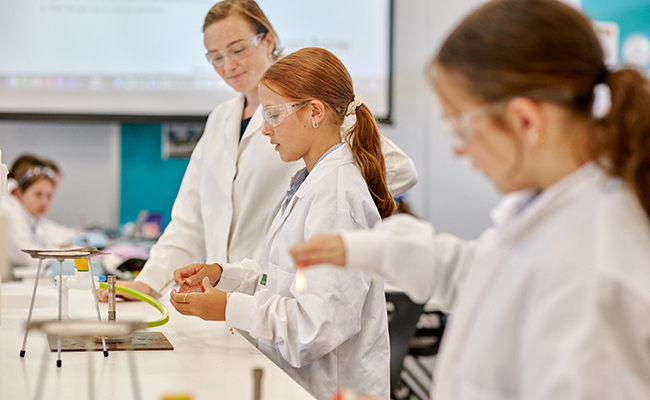
Today, Wednesday 11 February 2026, we celebrate the International Day of Women and Girls in Science. We are so fortunate to have such dedicated and knowledgable science staff here at SHC, who encourage and empower our students to study science. Our students in turn are hungry to learn, as we continue a strong tradition of teaching and learning about the world through science.
When asked the importance of studying science for our girls, some of our inspirational staff members gave the following responses:
Science is thriving at SHC! The International Day of Women and Girls in Science gives us a chance to acknowledge our creative and talented students who are pursuing their passions in the science field.
It is also a day reflect on the progress that has been made with women in STEM and breaking down barriers to their participation, and to commit ourselves to making sure every girl feels empowered to study science.
We are so fortunate to have passionate science teachers from all fields of science, including Biology, Chemistry, Physics, Psychology, Environmental Science and Sports Science who inspire students from Years 7 to 12 to get involved and see how wonderful the world of science is!
Stephanie Spizzica - Learning Designer - HAPE/Science
International Day of Women in Science is a chance to recognise the incredible contributions women make to our world. Science thrives on curiosity, problem-solving, and innovation. It is vital that girls see themselves in these roles - not just for the sake of representation, but because the world needs their unique perspectives. When we bring diverse voices to the lab, we unlock new ways of thinking and more creative solutions to global challenges.
At SHC, we strive to spark that 'aha!' moment, where a student’s mind becomes truly inquisitive about how the world works. As an SHC alumna, I know first-hand how a passionate teacher can change your trajectory. I remember being captivated by the energy of my own science teachers, which led me to study Psychology, Biology and Chemistry (and let’s be honest, Chemistry students truly are the best!).
I hope to provide my students with the same encouragement I received. By building confidence and critical thinking today, we ensure that the scientists, researchers, and innovators of tomorrow reflect the brilliance of all our students.
Deb Bohan, Chemistry Staff
Celebrating International Day of Women in Science holds great significance for me, having worked in this field for the best part of 35 years. It can be said that women bring new perspectives and diversity to research where groundbreaking discoveries are made, as well as their leading the way to improve gender equality. This day honours women scientists all over the world and encourages young women to further engage in science, inspiring them to pursue all interests no matter what.
I would love to encourage as many students as possible at SHC to study science through to year 12. Science subjects keep our students engaged in areas which have the breadth to develop their interest in areas beyond their imagination and providing them with multiple opportunities for more specialised future pathways once leaving school. Studying Science allows them to be problem solvers, to be creative and to also be an inspiration to other young women, so that together they can make a difference in the world. We want SHC students to know that the world can ‘truly be their oyster’; that they can turn their dreams into a reality!
I was privileged to attend SHC and graduated in 1984. I loved Maths and Science and in Year 12, the subjects I studied included Chemistry and Physics, as well as Pure Maths (Methods today). I also wanted to study Biology, but as I continued to study a language, I picked this up at university. My love of science began as a child as I loved to solve problems; something science was able to do most of the time! I was inspired by my teachers, who always reminded us that ‘we could do this!’ The support I was given enabled me to grow as a person, to feel valued in this field and empowered me to believe that I could do anything I wanted to do. My teachers were there to give me one-on-one assistance when required; something I continue to do with my students today. Having worked as a Medical Laboratory Scientist and now working as a Chemistry/Science teacher, I hope to inspire my students to pursue their interests in a field that is forever changing, and for them to bring their inquisitive minds to the fore.
Franca Bonanno, Chemistry Staff
Some students also gave their perspective on why they chose to study science:
The thing I love most about science is how it helps so many things in the world make sense. It has an explanation for every question, and it's really inspiring learning about all the work and research people have done to find those explanations.
Taking part in the Neuroscience course with John Monash opened up a whole world for me of all the complex and amazing things that our minds can do, and it really made me think differently about so many things in my own life which can be explained by science. Learning about the future of neuroscience and biological science was also super exciting, in terms of all the current research being done into neurons and stem cells and how they can function alongside technology.
There are so many advancements and new avenues of science being discovered all the time, and that constant evolution is what makes learning about science so exciting.
Selina Ortiz, Year 11
For me, science is about understanding how the world works. I love science because it challenges your assumptions and opinions and makes you question more about the universe.
Through Emerging Sciences Victoria, where I studied astrophysics, I was able to deepen my understanding and curiosity about the universe, and how it works and interacts. This strengthened my enthusiasm for science and motivated me to continue pursuing opportunities in STEM.
Charlotte Meilak, Year 11
For me, science is a passion that fascinates me because it allows me to understand how the world around me works, from the smallest particles to the endless expanses of space. It helps explain the processes that shape the entire universe and understand the complexities of everyday aspects. I am draw to the way it actively encourages critical thinking, innovation, and most importantly curiosity, which ultimately motivates me to further ask questions, explore, and experiment.
The most exciting experience I had in relation to science innovation was competing in the STAV Science Talent Search last year and am competing in again this year. The STAV Science Talent Search is a statewide science competition that calls on primary and high school students to demonstrate their passion for science and apply their creative and investigative skills to competition-based project work. Last year, I submitted entries into the Creative Writing and Poster categories, where I successfully won a Major Bursary Award for each, receiving a certificate, a medallion, and sponsorship. It was an experience that allowed me to independently research, investigate, and implement my creativity into different yet related scientific topics. And I was able to go beyond the content taught within the classroom and learn new, unique areas of knowledge.
Additionally, I am currently undertaking a neuroscience class through the Emerging Sciences Victoria Program where I learn and expand my knowledge about the brain: how it processes information, what influences thought, feelings, actions, and the implementation of technology into neuroscience.
Nevaeh Huynh, Year 10




 Call
Call Email
Email Visit
Visit